

In the demanding world of industrial power, a transformer doesn't just "fail" overnight. It sends out silent signals—invisible infrared signatures that, if caught early, can prevent catastrophic meltdowns and millions in unplanned downtime. By the time a transformer emits a burnt smell or an audible sizzle, the internal damage is often irreversible.
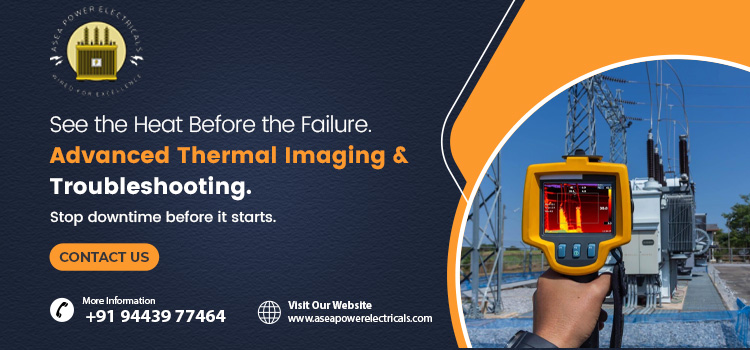
As we move through 2026, transformer troubleshooting has transitioned from reactive "firefighting" to predictive science. The most powerful weapon in this arsenal is Advanced Infrared Thermography (IRT). This non-destructive testing method allows engineers to "see" heat generated by resistive losses and insulation degradation long before it triggers a relay or a fire.
The Science of Winding Hotspots: What the Camera Really Sees
A transformer winding hotspot is more than just a "warm patch." It is a localized area of intense thermal stress where resistive losses ($I^2R$) or impaired heat dissipation cause temperatures to exceed the design limits of the insulation.
While traditional sensors measure the "Top Oil Temperature," we often miss these localized hotspots deep within the windings. Advanced Infrared Thermography works by capturing the infrared radiation emitted from the transformer tank and bushings. According to the Stefan-Boltzmann Law, the radiant energy is proportional to the fourth power of the absolute temperature ($E = \epsilon \sigma T^4$).
When conducting transformer troubleshooting, thermography reveals three critical "thermal signatures":
- 1.Phase Imbalance: Uneven heat across the three phases often points to unbalanced loading or internal winding defects.
- 2. Contact Resistance: Intense, pinpoint heat at the bushings or tap changer positions usually indicates loose bolts, oxidation, or poor solder joints.
- 3. Cooling Obstructions: "Cold" spots on radiators or cooling fins suggest blocked oil channels or failed pumps, which lead to internal heat accumulation.
Why Choose Asea Power Electricals for Transformer Troubleshooting?
In a landscape where many offer basic scans, Asea Power Electricals provides an engineering-first approach to transformer troubleshooting. We don't just hand you a colored image; we provide a diagnostic roadmap.
1. High-Resolution 2026 Optics
We utilize the latest long-wave infrared (LWIR) microbolometer sensors with thermal sensitivity as fine as $0.05°C$. This allows our technicians to detect the subtlest thermal gradients that basic handheld cameras might miss.
2. Beyond the Surface: Integrated Diagnostics
Thermal imaging is a surface-level scan. To provide a complete "Health Index," Asea Power Electricals integrates IRT with Dissolved Gas Analysis (DGA) and Partial Discharge (PD) detection. If we find a hotspot on the tank, we correlate it with gas ratios (like Ethylene and Acetylene) to determine if the cause is thermal degradation or electrical arcing.
3. Specialized Industrial Experience
With over 20 years of hands-on experience—from 11KV distribution units to massive 230KV grid transformers—our engineers understand the specific "thermal thumbprints" of different manufacturers and designs. We know the difference between a normal operating temperature and a critical failure point.
4. Safety-First Non-Invasive Procedures
Our troubleshooting is performed on live equipment under load. By using Infrared Inspection Windows, we eliminate the risk of arc flash, ensuring our team and your facility remain safe while we capture real-time operational data.
Don't Wait for the Alarm to Sound
Thermal imaging is the "X-ray" of the electrical world. By identifying winding hotspots today, you save your facility from the catastrophic costs of a transformer replacement tomorrow. At Asea Power Electricals, we turn thermal data into actionable engineering solutions.
FAQ: Transformer Troubleshooting
1. How often should infrared thermography be used for transformer troubleshooting?
For critical industrial transformers, we recommend a thermographic scan at least twice a year. However, if you notice an unexplained increase in energy expenditure or the unit is operating under a constant high load, quarterly inspections are advised to catch hotspots before they escalate into insulation failure.
2. Can thermal imaging detect internal winding faults during transformer troubleshooting?
While IRT primarily scans surface radiation, it is highly effective at identifying the symptoms of internal faults. For example, a localized hotspot on the tank wall often indicates a circulating current in the core or a short-circuit in the windings. For a definitive internal diagnosis, we combine IRT with a Sweep Frequency Response Analysis (SFRA).
3. What temperature rise is considered "critical" during a scan?
In general, if a connection or component is 15°C to 30°C above the ambient temperature or a neighboring phase, it requires "Prompt" attention. If the temperature difference exceeds 30°C, it is considered a "Critical" fault requiring immediate shutdown and repair to prevent fire or total failure.
4. Is thermography effective for both oil-filled and dry-type transformer troubleshooting?
Yes. In oil-filled units, it identifies cooling system failures and bushing issues. In dry-type (cast-resin) transformers, it is even more critical, as it can detect cracks in the resin and "tracking" across the insulation surface which are otherwise invisible.
5. Why is thermography preferred over traditional transformer troubleshooting methods?
Thermography is non-contact and non-destructive. Unlike traditional testing that requires equipment shutdown and disconnecting leads, IRT allows you to monitor the transformer while it is running at full capacity, providing a true "real-world" assessment of its health without interrupting your production.