

In the high-voltage ecosystem of 2026, the reliability of a power grid isn't just measured by the thickness of its cables, but by the "invisible strength" of the fluids within its transformers. Dielectric strength—the ability of an insulating material to withstand electrical stress without breaking down—is the heartbeat of transformer health.
When oil filling in transformer units is performed haphazardly, the result is often catastrophic arcing, leading to expensive downtime or total asset loss. At Asea Power Electricals, we view oil filling as a surgical procedure rather than a routine refill. This field guide explores the critical relationship between proper oil management and the prevention of electrical failure.
The Science of Arcing and Dielectric Breakdown
At its core, transformer oil serves two masters: it must cool the internal components and, more importantly, act as a primary insulator. Arcing occurs when the electric field intensity exceeds the dielectric strength of the oil. Instead of blocking the current, the oil becomes a conductor, allowing a high-energy arc to jump between the windings or to the tank wall.
The Three Enemies of Dielectric Strength
- 1. Micro-Bubbles (The Voids): Air has a significantly lower dielectric strength than oil. If air pockets are trapped during oil filling in transformer tanks, they become "weak spots." Under high voltage, these bubbles ionize, creating a path for partial discharge and eventual arcing.
- 2. Moisture (The Conductor): Water is the most dangerous contaminant. Even a moisture level of 30 parts per million (PPM) can slash the oil's breakdown voltage (BDV) by more than half.
- 3. Particulate Matter: Microscopic metal filings or carbon soot act as "conductive bridges." In a strong electric field, these particles align to form a chain, providing a literal highway for an electrical arc.
The 2026 Gold Standard: Vacuum Oil Filling
To achieve maximum dielectric strength, Asea Power Electricals utilizes the "Vacuum Filling" method. This is a non-negotiable standard for any transformer operating above 33kV.
- The Evacuation Phase: We begin by pulling a deep vacuum (often below 1 mbar) on the transformer tank. This removes all trapped air and "boils off" residual moisture from the solid cellulose insulation.
- The Degassing Process: The oil itself is processed through a double-stage vacuum unit, removing dissolved gases that could otherwise form bubbles during temperature fluctuations.
- Bottom-Up Injection: By injecting the processed oil from the bottom valve while maintaining a vacuum at the top, we ensure that every crevice of the winding is "wetted" without a single air pocket being trapped.
Why Choose Asea Power Electricals for the Oil Filling in Transformer?
For over 20 years, Asea Power Electricals has been the silent guardian of industrial and utility grids across Chennai and beyond. When you choose us for oil filling in transformer projects, you are investing in:
1. Advanced Mobile Filtration Fleet
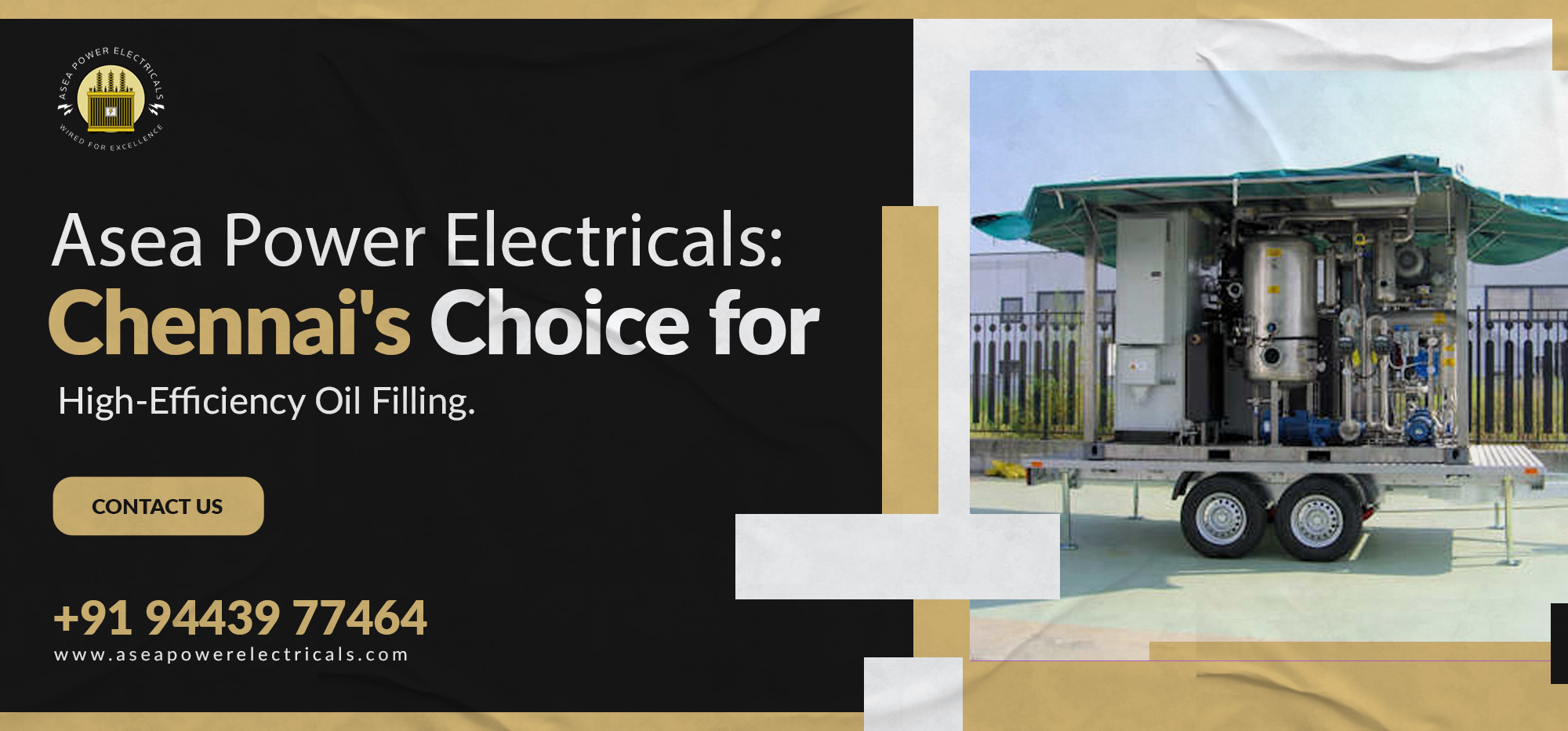
We bring factory-grade vacuum technology to your doorstep. Our mobile units are equipped with online moisture sensors and particle counters, providing real-time data during the filling process.
2. Precision Moisture Control
In 2026, "dry" isn't good enough. We target moisture levels of <5 PPM for EHV transformers, ensuring your asset enters service with the highest possible dielectric safety margin.
3. Certified Diagnostic Expertise
As part of the renowned Voltech Group ecosystem, our technicians are certified in IS 6792 and IEC 60156 standards. We don't just fill oil; we perform a comprehensive "Health Check" including Tan Delta and SFRA tests post-filling.
4. 24/7 Emergency Mobilization
Industrial power failures don't wait for business hours. Our on-site teams are ready to mobilize within hours for emergency oil top-ups or leak repairs, minimizing your operational losses.
Engineering Peace of Mind
Arcing is a symptom of poor preparation. By focusing on the microscopic details—PPM moisture levels, vacuum stability, and gas removal—Asea Power Electricals ensures your transformer isn't just filled, but fortified.
FAQ: Oil Filling in Transformer
1. Why is vacuum mandatory during oil filling in transformer units?
Vacuum is essential because it removes air and moisture trapped in the dense paper insulation of the windings. Without a vacuum, air bubbles remain lodged in the coils, which can lead to Partial Discharge (PD) and eventually a catastrophic internal arc when the transformer is energized.
2. How often should the oil level be checked in a transformer?
For industrial transformers, we recommend a visual oil level check every month and a comprehensive Breakdown Voltage (BDV) test every six months. If the oil level drops, it indicates a leak that must be addressed before refilling to prevent moisture ingress.
3. What is a "Good" BDV value for transformer oil in 2026?
For a 33kV transformer, the BDV should ideally be >50kV. For 132kV and 220kV units, Asea Power Electricals ensures the oil meets a BDV of >60kV to 70kV after our high-vacuum filling process.
4. Can I top up transformer oil with a different brand?
While you can mix different brands of mineral oil, they must be of the same base (e.g., both Naphtha-based). However, it is critical to perform an interfacial tension (IFT) test first. Mixing incompatible oils can lead to sludge formation, which clogs radiators and reduces cooling efficiency.
5. How does Asea Power Electricals handle environmental safety during oil filling?
We follow a "Zero-Spill" protocol. Every oil filling in transformer project includes secondary containment mats and high-integrity hose connections. We also manage the disposal of old, degraded oil through certified eco-friendly recycling channels.