

In 2026, the blueprint for public infrastructure has fundamentally shifted. For facilities where human life and safety are the absolute priority—specifically hospitals and educational institutions—the choice of electrical equipment is no longer just a technical decision; it is a life-safety mandate. Central to this shift is the rapid phase-out of traditional oil-filled units in favor of advanced dry-type technology.
As industries look for the best solutions in the oil filled vs dry type transformer debate, the push toward "liquid-free" gear is driven by one critical factor: the elimination of fire and environmental hazards in indoor spaces.
The Critical Safety Gap: Why "Oil-Free" is Non-Negotiable
For decades, mineral oil was the standard for transformer cooling. While effective, it carries a high "Flash Point" risk. In a hospital or school environment, even a minor electrical fault in an oil-immersed unit can lead to:
- Fire Propagation: Oil acts as a fuel source, potentially turning a local fault into a catastrophic fire.
- Toxic Fumes: Burning mineral oil releases thick, toxic smoke that makes evacuation in crowded buildings extremely difficult.
- Environmental Contamination: Any leak requires specialized hazardous waste cleanup to prevent soil and groundwater pollution.
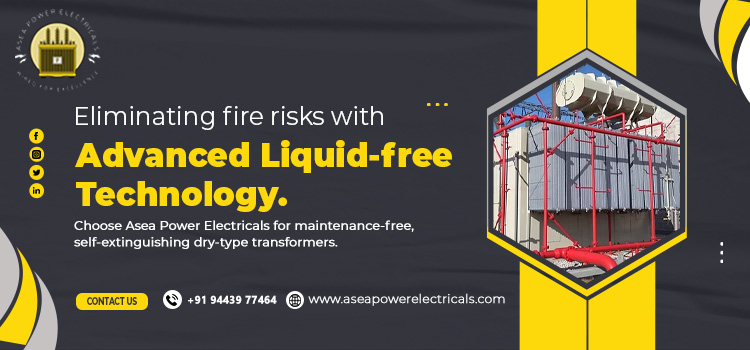
By contrast, modern dry-type transformers use air and solid insulation (like cast resin or epoxy). These materials are self-extinguishing and non-flammable, meaning we will not catch fire or sustain a flame even during a short circuit. This is why 2026 fire safety codes (like IS 2026 and international NFPA standards) increasingly restrict indoor oil installations to highly specialized, fireproof vaults—making dry-type units the more cost-effective and safer alternative.
Why Choose Asea Power Electricals for the Oil Filled vs Dry Type Transformer?
Navigating the transition to safer power distribution requires an engineering partner who understands both legacy systems and future-ready technology. Asea Power Electricals has established itself as a leader in this transition by providing high-performance solutions for both technologies.
1. Expertise in High-Safety Cast Resin Technology
We specialize in vacuum-cast resin (CRT) dry-type transformers. These units are moisture-proof and virtually maintenance-free, making them ideal for the humid and dusty environments often found in Indian infrastructure projects.
2. Comprehensive 20-Year Life Cycle Support
Whether you need a new installation or the repair of a legacy unit, Asea Power Electricals provides a full suite of services. From Oil Quality Analysis and filtration for existing outdoor units to Dielectric Strength Testing for modern dry-type gear, we ensure your assets perform safely for their entire lifespan.
3. Compliance with 2026 Safety Standards
With the implementation of new electrical safety omnibus regulations in 2026, compliance is mandatory. Asea Power Electricals ensures every unit we service or supply meets the latest BIS (Bureau of Indian Standards) and CEA (Central Electricity Authority) guidelines for fire resistance and efficiency.
4. Tailored Engineering for Public Spaces
We don't believe in one-size-fits-all. For schools, we focus on Low-Noise dry-type designs that don't disrupt the learning environment. For hospitals, we prioritize Overload Capacity to ensure life-saving equipment never loses power during peak demand.
Powering a Safer Future
The mandate is clear: for the spaces where we learn and heal, "safe enough" is no longer an option. Transitioning to liquid-free electrical gear is a vital step in modern fire protection.
At Asea Power Electricals, we are committed to guiding you through the complexities of the oil filled vs dry type transformer landscape. We help you choose the right technology that balances your budget with the ultimate priority—human safety.
FAQ: Oil Filled vs Dry Type Transformer
1. Which is safer for indoor use, an oil filled vs dry type transformer?
The dry-type transformer is significantly safer for indoor use. Because it contains no flammable liquids, it carries zero risk of oil leaks or explosions. This eliminates the need for expensive fire-suppression systems and dedicated oil-catchment pits required for oil-filled units.
2. What are the main maintenance differences in oil filled vs dry type transformer systems?
Oil-filled transformers require regular oil testing, filtration, and gasket checks to prevent leaks. In contrast, dry-type transformers are nearly maintenance-free, requiring only periodic cleaning of the cooling vents and thermal imaging to ensure optimal performance.
3. Can a dry-type transformer handle the same load as an oil-filled one?
While oil-filled units generally have better heat dissipation for ultra-high voltage (UHV) utility grids, modern dry-type transformers are perfectly suited for the medium-voltage needs of hospitals and schools (up to 35kV). They can be equipped with forced-air cooling to handle significant overloads during peak usage.
4. Is there a cost difference between oil filled vs dry type transformer installations?
Initially, dry-type transformers have a higher purchase price (roughly 20-30% more). However, when you factor in the "Total Cost of Ownership"—including the lack of oil maintenance, lower insurance premiums, and the absence of fireproof vaults—dry-type units often prove more economical over a 20-year period.
5. Why are hospitals switching from oil filled vs dry type transformer units in 2026?
Hospitals are switching due to strict 2026 safety mandates that prioritize smoke toxicity and fire suppression. Dry-type units provide a "clean" power solution that can be installed directly in basements or on rooftops close to the load center, reducing cable losses and maximizing patient safety.